Khokhloma: how wooden tableware turns golden without any gold
Drying oil, aluminium powder, varnish and the heat of a kiln: where Khokhloma's 'gold' comes from, and why the craft has two centres, Semyonov and Kovernino.
Cultural feature · checked 5 October 2026 · 5 min read
Published 5 October 2026
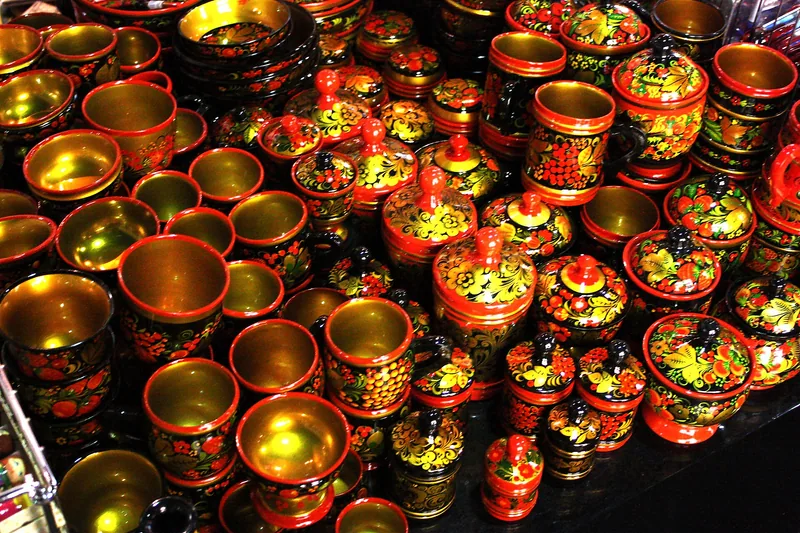

A wooden bowl, spoon or ladle painted in the Khokhloma style is recognisable at once: red berries and black curls on a warm golden ground, as if the tableware had come straight from a royal banquet hall. Yet ask the craftspeople how much gold went into such a bowl and the answer is surprising: not a gram. The shine that looks like precious metal comes from very ordinary things — a silvery powder, linseed oil, varnish and the heat of a kiln. That is the craft's main secret.
The painting takes its name from the trading village of Khokhloma, in today's Koverninsky District of the Nizhny Novgorod Region. Hardly anything was actually made there, though: the wares were brought to market from the surrounding forest villages along the Uzola River. The craft is more than three hundred years old, and over that time it has grown from a peasant sideline into work shown at world exhibitions. Today Khokhloma has two familiar addresses — the town of Semyonov and its historic homeland, Kovernino.
A trading village and forest hamlets
The painting took shape in the second half of the 17th century in villages of the Trans-Volga area — Bolshiye and Malyye Bezdeli, Mokushino, Khryashchi, Kovernino and others. The painted ware was taken to market in Khokhloma and spread across the country under that name. One early record, according to English-language Wikipedia, dates from 1659: a letter from the boyar Morozov orders a hundred painted dishes rubbed with powdered tin. So the trick of 'gilding without gold' was already known by then.
Nobody knows for certain where the technique itself came from, but a popular explanation links it to the Old Believers. Opponents of Patriarch Nikon's reforms withdrew into the remote Trans-Volga forests and brought icon-painting skills with them. They knew how to 'gild' icon covers and backgrounds using a silvery metal and drying oil. Carrying the method over from icons to everyday wooden tableware was a natural step — and so, by this account, a church craft became a peasant one.
Silver that will become gold
The work begins with wood, usually lime, aspen or birch. A rough block, called a baklusha, is fixed on a lathe and turned into a bowl, a dish or a lidded container. The piece is then primed, traditionally using clay: the primer fills the pores of the wood so that it does not soak up the later layers. After that it is coated several times with drying oil — boiled linseed oil — and each coat is left to dry until the surface is slightly tacky.
The next stage is known as tinning. A fine metal powder is rubbed into the tacky surface: in the old days it was tin, sometimes silver, and today it is aluminium. The piece turns a matt silver, and only on this base is it painted. Then it is coated with varnish and hardened in a kiln. As it heats, the varnish turns yellow, the silvery metal shows through it and takes on a warm honey tone. That is how Khokhloma's famous 'gold' is born.
Top painting and background painting
Khokhloma's palette is limited to what can survive the heat of the kiln: the main colours are black, red and gold, joined by yellow, orange, green and brown. Painters use oil paints with mineral pigments and fine squirrel-hair brushes. In top painting the artist lays the pattern directly over the silvery layer. The result is free-flowing 'grass' made of curls, blades, sedge strokes, droplets, tendrils and little bushes, often with leaves and berries added.
Background painting works the other way round. First the outline of the design is drawn on the metal base, and then all the space around it is filled with red or black. The unpainted areas turn golden in the kiln, so the pattern seems to glow out of a dark ground. This demands a particularly precise hand. One variety of background painting is kudrina: lush curling leaves and flowers that are thought to go back to the ornaments of old handwritten books.
Semyonov and Kovernino
The town of Semyonov is called Khokhloma's second home. A convenient railway connection helped it become the industrial centre, and in 1916 a school of artistic woodworking opened here, later becoming a technical college. In 1929–1931 local craftsmen joined together in cooperatives, which grew into the Khokhloma Painting factory in 1961. In 2009 the factory opened the Golden Khokhloma museum, and since 1993 the town has hosted the Golden Khokhloma festival.
Kovernino remains the craft's historic homeland: Khokhloma painting even appears on the settlement's coat of arms. Here, in the village of Sukhonoska, the Khokhloma workshop is still at work, and all around lie the very villages from which tableware was once taken to market. Recognition came long ago: pieces were shown at the All-Russian Industrial Exhibition of 1853 in Moscow, and at the 1889 World's Fair in Paris they won the Grand Prix. Since then Khokhloma has become one of the best-known symbols of Russian art.
Sources & context
- Znanie.Wiki (Znanie Russian Society) — Khokhloma
- Gateway to Russia — Khokhloma: all you need to know about the 'gold' painted tableware
- Advantour — Khokhloma Painting factory, Semyonov
- Wikipedia — Khokhloma
A russia.direct editorial selection based on open sources. Checked 5 October 2026. Practical suggestions are a decision guide, not a promise of outcomes.
Editorial principles