Pomors: people of the White Sea, karbas boats and northern speech
Who the Pomors are, what they sailed, how their speech sounds, and where near Arkhangelsk to see the wooden world of the Russian North.
Cultural feature · checked 30 September 2026 · 5 min read
Published 30 September 2026

The word “Pomor” explains itself: pomorye means the land “by the sea”, along the shore. It is the name for people whose ancestors, mostly settlers from Veliky Novgorod, made their homes on the coasts of the White Sea and neighbouring lands. Today most Pomors live in the Arkhangelsk Region. The Pomors are not a separate people in the strict sense but an ethnographic group of Russians with their own way of life, crafts and speech, shaped over centuries beside a cold sea.
Each stretch of coast here has its own name: the Winter, Summer, Tersky, Karelian and Pomorsky coasts. For centuries life on them was shaped by the sea, which fed people, linked the villages and drew seafarers far to the east, to the shores of Siberia. The names of the coasts read like lines from a sailing directory, and behind each lie villages, trades and family histories that the North still remembers.
Life by a cold sea
The Pomor economy rested on fishing, hunting sea mammals and trade. Farming on the harsh shore yielded little, but the sea was generous with fish, and seafaring skill let people carry goods where no overland roads led. The sea demanded knowledge of winds, currents and tides, and that knowledge was handed down from father to son as carefully as a boat or nets.
Pomors played a notable part in the opening of Siberia: many joined expeditions eastward and helped found settlements, among them early-17th-century Mangazeya. Pomor culture is also associated with Mezen painting, bone carving and its own ceramics. The patterns of Mezen painting and delicate bone carving show that a hard life by the sea by no means excluded a love of beauty and decorative art.
The karbas, workhorse of Pomorye
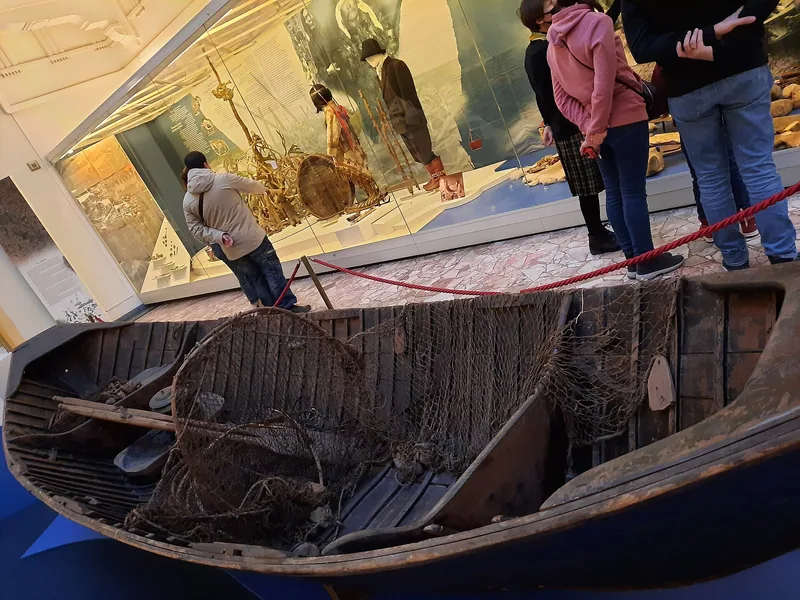
The coast’s main boat was the karbas. As craftsmen reviving the old technique told TASS, its planks were traditionally “sewn” together with twisted birch withies instead of nails, and for the strongest hull parts builders used kokory, sections of trunk with the root attached. Karbas boats are mentioned in Solovetsky Monastery records from 1531. This construction made the boat flexible: it took the blows of the waves better and was easier to repair far from any shipyard.
Every household had a karbas: people used it to go to sea, to fish and to carry passengers and cargo. According to the craftsmen, a six-metre boat could be built in under two weeks and served for about fifteen years. A reconstructed nine-metre karbas with two masts and three pairs of oars took about two months to build. Today enthusiasts and sea-skills clubs are again building karbas boats with the old techniques and sailing them, to keep the living experience of Pomor seafaring alive.
The koch and the long routes
For long Arctic voyages the Pomors built the koch. Below the waterline its hull had rounded lines and extra ice sheathing, so a vessel caught in the ice was squeezed upward rather than crushed. A koch usually carried one mast with a square sail, and its keel measured roughly 10 to 25 metres. The design was an answer to the main danger of northern seas, being crushed by ice, and it shows the practical ingenuity of Pomor shipwrights.
Koch building developed as the White Sea coasts were settled and flourished in the 15th and 16th centuries. In 1715 a decree of Peter I required ships to be built in the “new manner”, and the age of the koch gradually passed, though it lives on in Pomor stories and museum models. The koch remains a symbol of how far people who knew their sea well could travel in small wooden vessels.
Speech and wooden architecture
Pomor speech, which its speakers call govorya, is recognised by its full “o” vowels and by tsokanye: instead of chai, “tea”, you may hear tsai. Linguists also note contracted forms such as znash and delash for “you know” and “you do”, and words still heard in Arkhangelsk today, such as dak, “so”, and seigod, “this year”. For many northerners this speech is not a curiosity but part of who they are. The remoteness of the coastal villages, where speech was passed down in families for centuries with little outside influence, did much to preserve these features.
To see the world the Pomors lived in, visit the Malye Korely museum of wooden architecture, about 25 kilometres from Arkhangelsk on the Northern Dvina. Founded in 1964 and open to visitors since 1973, it gathers 86 monuments on some 140 hectares: churches, chapels, peasant houses and mills from different parts of the region. Check opening hours and tour programmes on the official website, korely.ru. A walk among old log houses and tent-roofed churches on the riverbank conveys the scale and dignity of northern wooden architecture better than any book.
Sources & context
- Malye Korely Museum — about the museum
- TASS — By karbas from the 15th to the 21st century
- AiF Arkhangelsk — What gives away a Pomor speaker?
- Wikipedia — Pomors
- Wikipedia — Koch (boat); Malye Korely
A russia.direct editorial selection based on open sources. Checked 30 September 2026. Practical suggestions are a decision guide, not a promise of outcomes.
Editorial principles