Yaroslavl: a city composed around two rivers
The Volga and Kotorosl, old churches and classical streets: discover the relationships that give the city its shape.
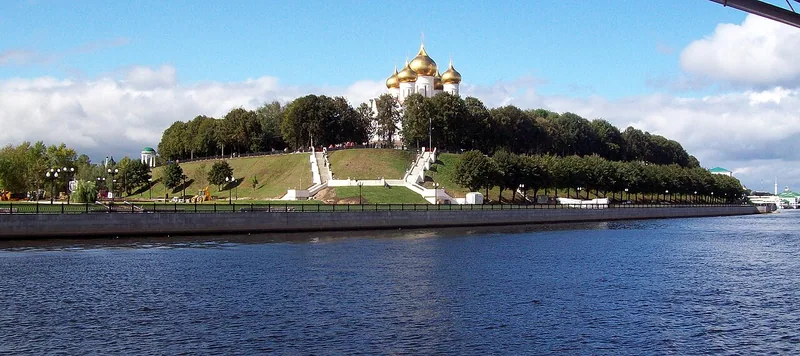

Begin exploring Yaroslavl with a simple question: why does the city look so convincing from this particular spot? Water and individual buildings attract attention first; the spaces between them emerge a moment later. This feature suggests reading the historic centre as a connected composition, rather than a checklist of sights.
Move between three scales: a panorama from the riverbank, a view along a street and a small detail on a facade. The approach works equally well for residents rediscovering familiar surroundings and for visitors encountering an Upper Volga city for the first time.
Let the water explain the city
Yaroslavl stands where the Kotorosl joins the Volga. UNESCO identifies the relationship between the buildings and the two rivers as an important quality of the historic centre. The riverbank is therefore a useful starting point for understanding both the geography and the way the city reveals itself.
Choose one stretch of embankment and a nearby street on a map. Look along the water, then turn towards the buildings. Where does a prominent tower or roofline appear? What remains visible between houses? Try taking two photographs from the same position in different directions: together they may say more about the city than several isolated monuments.
Older churches within a later urban order
The historic centre entered the World Heritage List in 2005. Its significance includes the combination of 17th-century churches with the regular planning of the Neoclassical period. The later urban structure retained older buildings as prominent landmarks, making the relationships between different eras especially rewarding to observe.
Compare the varied outline of a church ensemble with the repeated windows, cornices and floors of neighbouring civic buildings. This is an editorial exercise in looking, not a test of taste. There is no need to decide which period is better: the interest lies in seeing different architectural rhythms share a street.
The museum reserve and the work of conservation
The Yaroslavl Museum Reserve occupies the former Transfiguration Monastery ensemble. Its website identifies the cathedral, Holy Gates, Refectory Chamber and lower level of the belfry among the surviving early stone structures. Consider them as parts of an ensemble with different functions, rather than interchangeable historic buildings.
The museum also describes the contribution of successive generations of restorers and the display of collections in restored interiors since 1959. Ask what changes a building has experienced and what evidence informed the restoration of a detail. That question brings the work of conservation into the story of the city.
Build a walk of your own
For a first encounter, connect an embankment, a few streets and one museum ensemble. Leave time to stop and return to a view you liked. Keep your own observations separate from facts learned from a museum label: both matter, but they tell you different things.
Check official opening information and access to individual interiors before visiting. Save the Cyrillic names Ярославль, Волга and Которосль alongside Yaroslavl, Volga and Kotorosl to help match signs with your map. If you stay longer, repeat the same short walk in different light. A familiar route can become a new exercise in attention.
Sources & context
A russia.direct editorial selection based on open sources. Checked 24 September 2026. Practical suggestions are a decision guide, not a promise of outcomes.
Editorial principles